
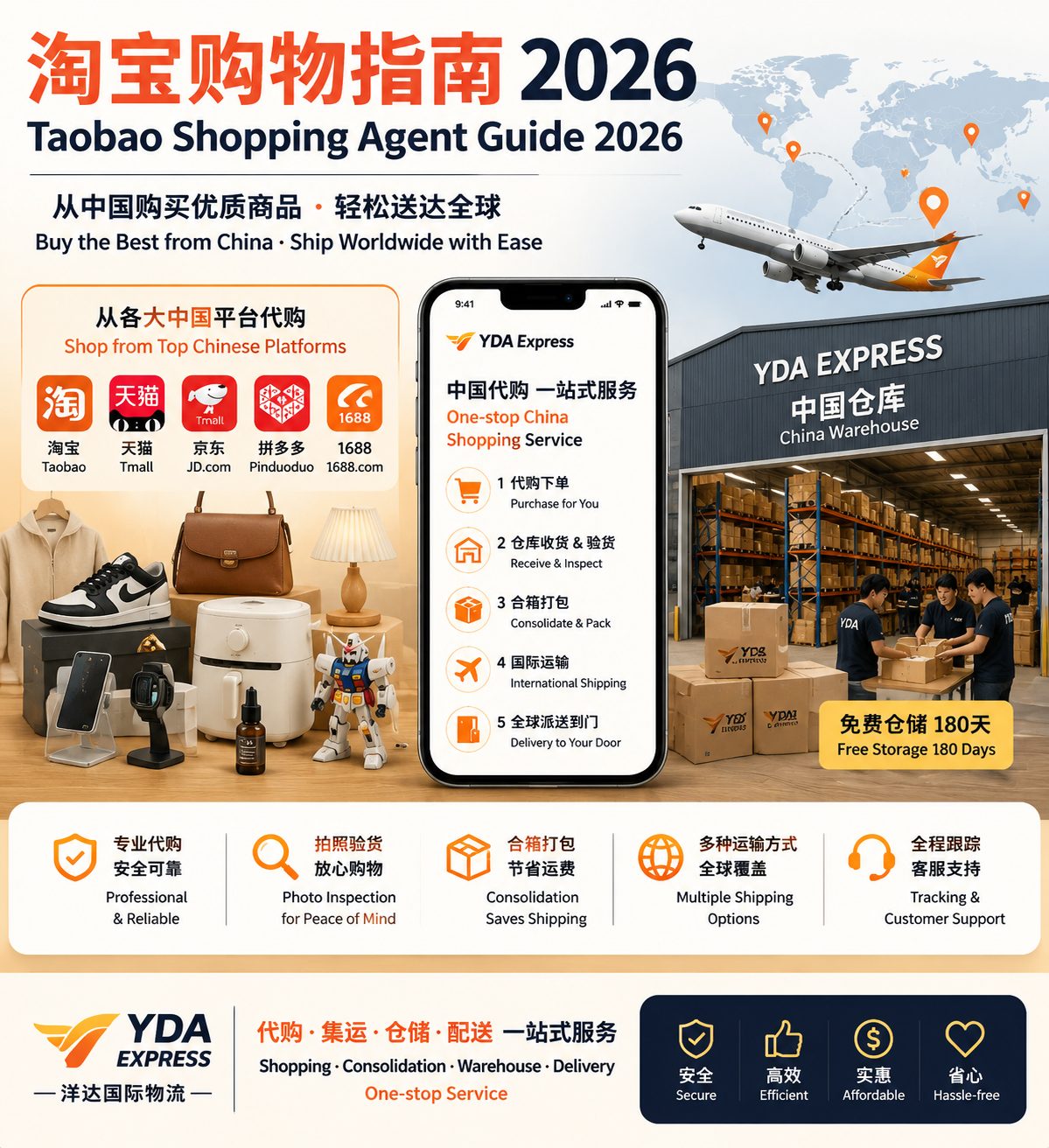
Follow the complete Taobao agent process: submit product links, confirm and pay for orders, check warehouse arrivals, handle returns, consolidate parcels and ship internationally.
Using a Taobao agent is a sequence of decisions: submit the correct product, confirm the order, receive it at a warehouse in China, check the parcel, combine compatible purchases and choose an international shipping route.
This guide explains how to use a Taobao agent step by step. It focuses on the operational process rather than defining the service or ranking providers.
Taobao agent process at a glance
| Stage | Buyer’s task | Agent or warehouse task |
|---|---|---|
| Product selection | Choose the exact listing and variant | Review the request |
| Quotation | Confirm quantity and requirements | Check price and applicable charges |
| Purchase | Approve and pay | Place the domestic order |
| Domestic delivery | Monitor order status | Track receipt at the China warehouse |
| Warehouse check | Review photos and findings | Record and perform agreed checks |
| Problem handling | Approve return or replacement | Communicate with the seller |
| Consolidation | Select parcels and packing needs | Combine compatible goods |
| Shipping | Choose route and insurance | Pack and dispatch |
| Delivery | Monitor customs and last mile | Provide available tracking support |
Before step 1: prepare the order information
For every Taobao item, collect:
- Product URL.
- Shop or seller name.
- Selected colour.
- Size.
- Model or version.
- Quantity.
- Product image.
- Important material or compatibility requirements.
- Whether a substitute is acceptable.
- Destination country and postcode.
- Any known battery, liquid, magnet or branded-product characteristics.
Do not rely on an image alone. A listing can contain many variants with different prices and specifications.
For help evaluating products and sellers before ordering, use the dedicated Taobao product and seller guide.
Step 1: submit the product link
Enter or send the product URL through the agent’s supported order channel. If the listing has several variants, copy the exact option names and provide a screenshot when helpful.
Check that the submitted request shows:
- Correct product.
- Correct seller.
- Correct variant.
- Correct quantity.
- Current displayed price.
- Seller’s domestic delivery information.
If the listing is unclear, ask the agent to confirm the details with the seller before purchase.
Step 2: review the quotation
The initial amount can include:
- Product price.
- Domestic shipping to the warehouse.
- Purchasing service fee.
- Payment or exchange charges.
- Optional order services.
Warehouse services and international shipping may be calculated later because the final parcel weight and dimensions are not yet known.
Before paying, ask which amounts are:
- Confirmed.
- Estimated.
- Optional.
- Refundable.
- Payable after warehouse arrival.
Do not approve a quotation that uses the wrong quantity or product version. For the complete fee structure, see the China shopping agent cost guide.
Step 3: approve and pay for the order
After checking the quotation, follow the provider’s supported payment method.
Save:
- Order number.
- Product link.
- Selected options.
- Amount paid.
- Exchange rate when applicable.
- Payment receipt.
- Written seller instructions.
- Expected domestic dispatch period.
The agent should not change an important variant or accept a substitute without customer approval.
Step 4: the agent purchases from Taobao
After payment confirmation, the agent places the order. Monitor whether the order is:
- Awaiting purchase.
- Purchased.
- Awaiting seller dispatch.
- Shipped domestically.
- Delivered to the warehouse.
- Cancelled or refunded.
Possible exceptions include:
- Price change.
- Product out of stock.
- Seller requests a different option.
- Domestic shipping changes.
- Seller does not dispatch.
- Listing is removed.
- Product is unsupported.
Respond quickly when approval is required because promotions, stock and domestic return windows can be time-sensitive.
Step 5: track domestic delivery
The Taobao seller ships to the agent’s warehouse inside China. Each seller normally sends a separate domestic parcel.
Record the domestic tracking number if available. When several items are ordered from the same shop, confirm whether they are sent together or in separate parcels.
A “delivered” carrier status does not always mean the parcel has already been registered in the customer’s warehouse account. Warehouse processing can occur after carrier delivery.
Step 6: verify warehouse registration
When the parcel is recorded, check:
- Order or parcel number.
- Seller or domestic tracking number.
- Arrival date.
- Recorded weight.
- Recorded dimensions when available.
- Number of items or packages.
- Basic arrival photos.
- Storage deadline.
If you cannot match a parcel to an order, compare the domestic tracking number and contact support before requesting international shipment.
Step 7: review photos and request checks
The basic warehouse service may provide only limited visible information. Review what is actually shown.
Possible checks include:
- Quantity.
- Colour.
- Size label.
- Model.
- Visible damage.
- Included accessories.
- Packaging condition.
- Basic measurements.
- Additional photographs.
- Simple functional check when offered and appropriate.
Write inspection requests as specific questions. “Check the quality” is too vague. Better requests include:
- Photograph the size label.
- Measure the width in centimetres.
- Confirm that two accessories are included.
- Photograph the connector and model number.
- Check for visible cracks on all sides.
A basic check cannot prove authenticity, composition, safety or compliance.
Step 8: handle a wrong or damaged item
If a problem is found while the product is still in China:
- Save the warehouse photos.
- Compare the item with the approved order details.
- Identify the exact problem.
- Ask whether the seller’s return period remains open.
- Request the available return, exchange or partial-refund options.
- Review domestic shipping and handling charges.
- Approve the chosen action in writing.
- Track the returned parcel or replacement.
A return may be refused when the product is customized, opened, used, outside the deadline or excluded by the seller’s policy.
Do not ship a disputed product internationally until the domestic resolution is clear.
Step 9: wait for all intended parcels
If you ordered from several sellers, create a parcel list:
| Seller/order | Domestic tracking | Warehouse status | Check completed | Include in shipment |
|---|---|---|---|---|
| Order 1 | ||||
| Order 2 | ||||
| Order 3 |
Before consolidation, confirm:
- All expected parcels have arrived.
- Returns and replacements are complete.
- Required checks are finished.
- Storage deadlines have not passed.
- Restricted products have been identified.
- You know which parcels should remain separate.
Submitting consolidation too early can leave a late parcel behind.
Step 10: request consolidation and packing
Select the parcels for one international shipment and state the packing requirements.
Possible requests include:
- Remove unnecessary seller mailers.
- Keep retail packaging.
- Add protective materials.
- Separate fragile and heavy goods.
- Protect corners.
- Use a stronger carton.
- Vacuum-pack suitable textiles.
- Split restricted products.
- Photograph the final packing when available.
Consolidation is not suitable for every combination. Batteries, liquids, fragile items, food, oversized goods or products with different customs treatment may need separate parcels or routes.
Step 11: check final weight and dimensions
After packing, review:
- Actual weight.
- Length, width and height.
- Volumetric-weight formula.
- Chargeable weight.
- Number of cartons.
- Packing materials.
- Declared contents.
- Any oversized or product surcharge.
Carriers can charge the higher of actual and volumetric weight. Do not compare shipping routes using only product weight.
Step 12: compare international shipping routes
Request routes that accept the exact contents and destination.
Compare:
| Factor | Route A | Route B | Route C |
|---|---|---|---|
| Product accepted | |||
| Chargeable weight | |||
| Shipping charge | |||
| Transit estimate | |||
| Tracking | |||
| Insurance | |||
| Customs terms | |||
| Destination fees | |||
| Delivery method |
Ask whether import charges are prepaid or collected from the recipient. Estimated transit time is not a guaranteed delivery date.
Step 13: review customs information
Before dispatch, confirm that the shipment description and declared information are accurate.
The customer should verify:
- Product restrictions in the destination country.
- Import permits when required.
- Duties and taxes.
- Recipient identification requirements.
- Commercial vs. personal import treatment.
- Intellectual-property risks.
- Product safety and labelling requirements.
Do not ask a provider to misdescribe or undervalue goods.
Step 14: choose insurance
Review:
- Covered events.
- Excluded products.
- Insured value.
- Maximum compensation.
- Evidence required.
- Claim deadline.
- Whether shipping charges are covered.
- Whether fragile or restricted goods qualify.
Insurance terms should be available before international dispatch.
Step 15: approve international dispatch
Complete a final check:
- Correct parcels selected.
- Returns and replacements resolved.
- Packing requirements completed.
- Final weight and dimensions reviewed.
- Shipping route accepts the contents.
- Recipient name is correct.
- Address and postcode are correct.
- Phone number and email are correct.
- Customs terms understood.
- Insurance decision recorded.
- Total shipping amount approved.
After dispatch, changing the address, contents or route may be impossible.
Step 16: monitor tracking
International tracking can contain several stages:
- Label created.
- Warehouse handover.
- Export processing.
- Departure from China.
- Arrival in destination country.
- Customs processing.
- Transfer to local delivery.
- Out for delivery.
- Delivered.
A label-created status does not always mean the parcel has physically departed. Use the carrier or supported tracking channel and keep screenshots if an update appears abnormal.
Step 17: respond to customs or delivery requests
The carrier or customs authority may request:
- Proof of purchase.
- Payment receipt.
- Product description.
- Recipient identification.
- Tax payment.
- Import permit.
- Authorization for clearance.
Respond through verified channels and keep copies. Confirm unexpected payment requests with the carrier before paying.
Step 18: inspect the delivered parcel
When the parcel arrives:
- Photograph the outer carton before opening if damage is visible.
- Record the shipping label.
- Photograph the opening process for a valuable or damaged shipment.
- Compare the contents with the packing list.
- Test products promptly.
- Keep packaging until the goods are confirmed.
- Report missing or damaged goods within the applicable deadline.
Claims often require photos, purchase evidence, warehouse records and carrier documentation.
Common process mistakes
Selecting the wrong variant
Prevent this by writing the exact colour, size and model and confirming them before payment.
Assuming every photo is a full inspection
Define the required checks and understand their limits.
Consolidating before all parcels arrive
Maintain a parcel list and wait until returns or replacements are complete.
Choosing shipping before final packing
Compare routes using final dimensions and chargeable weight.
Ignoring storage deadlines
Record the free-storage period and expected arrival date for every parcel.
Mixing incompatible products
Ask whether all goods can share one carton and one route.
Using incomplete recipient information
Match the destination’s address and identification requirements.
Taobao agent workflow checklist
Before purchase
- Correct product URL.
- Seller and variant confirmed.
- Quantity confirmed.
- Important specifications written.
- Charges reviewed.
- Product restrictions considered.
At the warehouse
- All parcels matched to orders.
- Photos reviewed.
- Required checks completed.
- Problems resolved.
- Storage dates checked.
Before shipping
- Parcels selected.
- Packing approved.
- Final measurements reviewed.
- Route compared.
- Customs terms understood.
- Insurance decided.
- Address verified.
After delivery
- Outer carton documented.
- Contents counted.
- Products checked.
- Evidence retained.
- Problems reported promptly.
Frequently asked questions
Do I need a Chinese Taobao account?
Not necessarily when the agent places the order on your behalf. The provider’s exact submission and payment process varies.
Can I change a Taobao order after payment?
Possibly, but only before the seller processes or ships it. Contact the agent immediately; changes are not guaranteed.
How long should I wait before consolidation?
Wait until every intended parcel has arrived and all inspections, returns and replacements are complete. Also monitor storage deadlines.
Can all Taobao products use the same shipping route?
No. Batteries, liquids, magnets, food, cosmetics, branded goods and oversized products can have different restrictions.
Is international shipping included in the purchase quotation?
It is often calculated after warehouse arrival and packing because the final chargeable weight is not yet known. Confirm the provider’s pricing structure.
What if the parcel is delivered to the warehouse but not visible?
Allow for warehouse registration time, then provide the domestic tracking number and order details to support.
Continue with the page matching your question
This page explains how to use a Taobao agent from order submission to delivery.
- For the definition, read what a Taobao agent is.
- For provider comparison, read how to choose the best Taobao agent.
- For product and seller checks, read how to buy more safely on Taobao.
- To submit product links, use the shopping service.